Step 1: Shut Off Water and Power (0 to 5 Minutes)
- Close the dishwasher supply valve under the sink. Turn the handle clockwise until it stops. If the valve is seized, shut off the main at the meter.
- Kill the dishwasher circuit at the breaker panel. Standard amperage is 15A or 20A on a dedicated circuit.
- Open the dishwasher door and remove the bottom rack to expose the sump and any standing water.
- Photograph the appliance, the floor, and the cabinet interior before you move anything. Insurance adjusters require pre-mitigation documentation.
- Place a shallow tray or folded towels under the front lip of the unit to catch residual discharge when you tilt it forward later.
Step 2: Identify the Leak Source
- Inspect the braided supply line at the inlet valve for pinhole sprays or corrosion at the brass fitting.
- Check the drain hose loop where it connects to the air gap or disposal. Loose clamps cause 30 to 40 percent of slow leaks.
- Examine the door gasket for compression set or food debris breaking the seal.
- Pull the lower kick plate and look at the pump housing and float switch for active drips.
- Inspect the heating element gasket on the tub floor. A cracked seal here often masquerades as a door leak because water travels forward during the wash cycle.
- If the leak originates from the dishwasher tub itself, the unit is typically beyond repair and replacement runs $600 to $1,400 installed.
Step 4: Map Moisture With Meters
Visible water is roughly 20 percent of the problem. The remaining 80 percent sits in subfloor, wall cavities, and cabinet substrate. A proper water damage restoration response in Belleville starts with a moisture map.
- Use a pin meter on hardwood. Dry baseline reads 6 to 9 percent moisture content. Anything above 16 percent requires drying.
- Use a non-invasive meter on tile, vinyl, and laminate. Compare readings to an unaffected room of the same material.
- Drill 1/8 inch inspection holes at the base of cabinet kick plates to check subfloor MC. Plug them after.
- Mark every wet boundary with painter's tape. This becomes your drying perimeter.
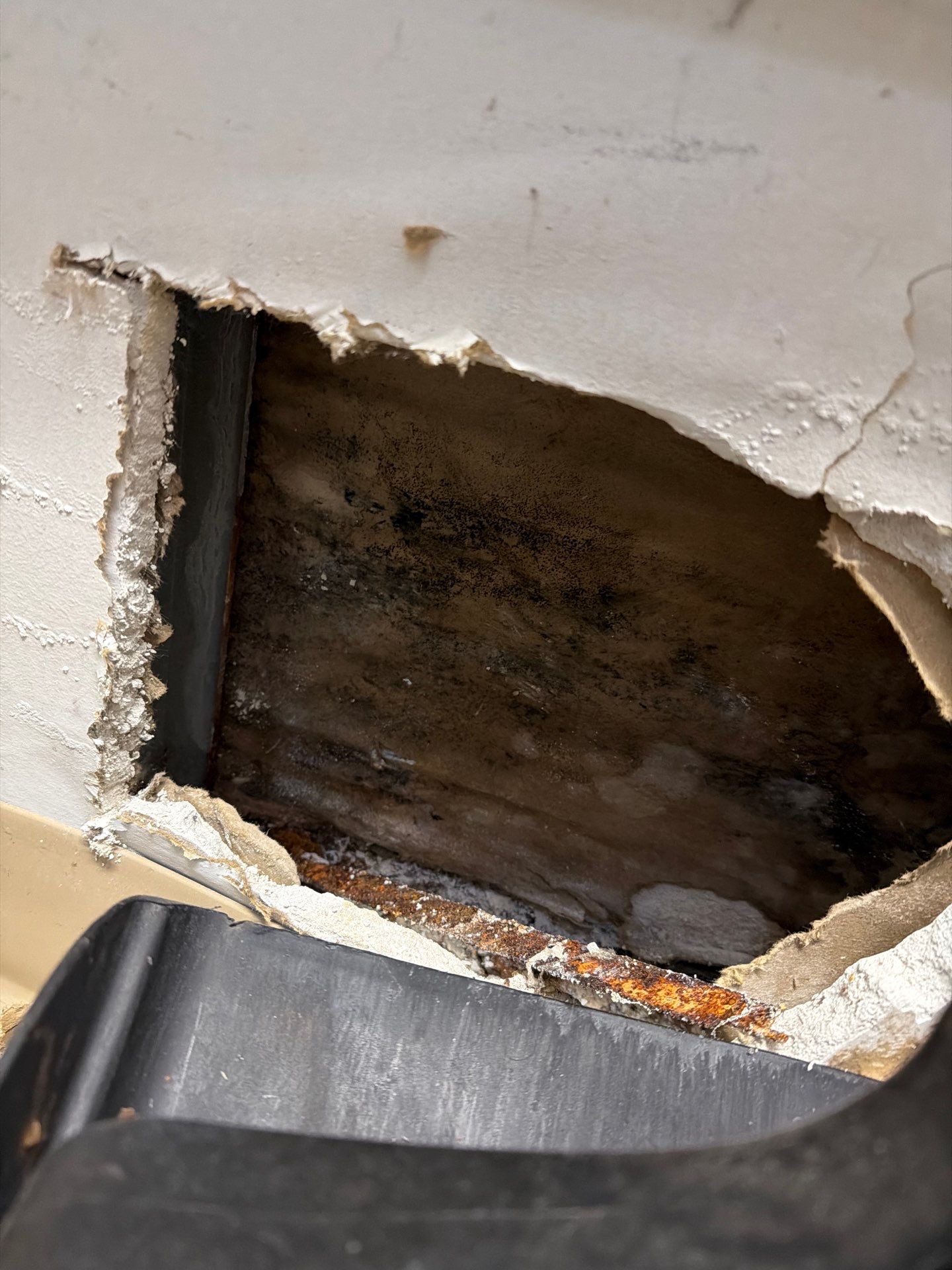
- Scan the shared wall behind the dishwasher with a thermal camera. Cold signatures 12 to 18 inches up the drywall confirm wicking into the stud bay.
Step 5: Decide What Stays and What Goes
- Engineered hardwood with delamination or cupping over 1/16 inch: remove. It will not dry flat.
- Solid hardwood with cupping under 1/16 inch and MC under 24 percent: dry in place with directed airflow.
- Laminate with swollen edges or popped seams: remove. The fiberboard core is destroyed once wet.
- Vinyl plank with water trapped underneath: lift 8 to 10 planks to vent, then dry the subfloor.
- Tile with hollow sound when tapped: thinset bond has failed. Remove affected field.
- OSB or plywood subfloor above 28 percent MC for more than 72 hours: cut and replace. Swollen OSB does not return to spec.
- Particleboard cabinet bases: replace any panel showing edge swell over 1/32 inch. Sealing wet particleboard traps moisture and feeds mold.
Step 9: Prevent the Next Leak
- Replace rubber supply lines with braided stainless every 5 to 7 years. Failure rate climbs sharply after year 8.
- Install a leak detection puck under the dishwasher tied to an auto-shutoff valve. Hardware runs $180 to $420.
- Verify the high loop on the drain hose. The loop must rise to at least 32 inches before connecting to the disposal.
- Run an empty hot cycle with citric acid every 60 days to clear food sludge from the sump and check valve.
Step 3: Extract Standing Water
- Use a wet/dry vacuum rated for at least 5 gallons. Extract every visible pool from tile grout, hardwood seams, and vinyl edges.
- Pull the kick plate off the adjacent cabinets. Water tracks laterally under cabinet boxes within minutes.
- Lift any loose flooring that releases without force. Do not pry glued material yet.
- Place absorbent towels along the cabinet base and replace them every 15 minutes until they come up dry.
- Check the basement ceiling or crawl space directly below the dishwasher. Water that penetrates the subfloor seam will surface there within 30 to 90 minutes.
Step 7: Verify Dry Standard
- Hardwood: MC within 2 to 4 percentage points of the unaffected baseline.
- Subfloor: MC at or below 16 percent.
- Drywall: under 1 percent on a non-invasive scanner.
- Cabinet substrate: under 16 percent on a pin meter.
- Typical structural dry time runs 3 to 5 days. Hardwood may extend to 7 to 10 days.
- Take three readings per material at different depths and locations. A single dry reading does not confirm a dry assembly.
Step 8: Reconstruction Specifications
- Subfloor replacement: match existing thickness (typically 3/4 inch tongue and groove plywood). Glue and screw at 6 inch perimeter, 12 inch field.
- Cabinet kick plate and toe-kick: replace with 1/4 inch finish-grade plywood, primed on all six sides.
- Flooring replacement: order 10 percent overage for cuts and future repairs.
- Baseboard: prime cut ends before reinstallation to block wicking.
- Re-caulk the dishwasher perimeter with 100 percent silicone after the new unit is set.
- Acclimate replacement hardwood in the kitchen for 5 to 7 days before installation. Skipping this step causes seasonal gaps within 90 days.
Step 6: Set the Drying Chamber
- Deploy one LGR dehumidifier per 1,000 to 1,500 cubic feet of affected space. Target 30 to 40 percent relative humidity.
- Set air movers at a 15 to 45 degree angle to the wet surface. One unit per 10 to 16 linear feet of wall.
- Inject air into wet cabinet bases using a cavity drying tool or by drilling 1 inch holes in the kick plate.
- Maintain a chamber temperature of 75 to 85 degrees F. Warmer air holds more moisture and accelerates evaporation.
- Monitor and log temperature, RH, and grains per pound every 24 hours.
- Seal the kitchen entry with 6 mil poly and a zipper door if adjacent rooms are dry. Containment cuts dehumidifier load by 40 to 60 percent.
Step 10: Document for Insurance
- Sudden and accidental discharge from a dishwasher is covered under most HO-3 policies. Gradual seepage usually is not.
- Submit moisture logs, psychrometric readings, photo documentation, and a Xactimate estimate.
- Belleville Water Restoration bills carriers directly and assigns a project manager to your claim. Average dishwasher loss claims in Belleville settle between $2,800 and $9,500 depending on flooring type and subfloor damage.
If your loss involves multiple rooms or finished basement intrusion, our flooded basement cleanup guide covers the next layer of containment, and our restoration cost breakdown details line-item pricing for Belleville homeowners filing claims.